Samarkand: Where Time Wears a Turquoise Crown
Samarkand: Where Time Wears a Turquoise Crown
Step into Samarkand, and it feels as though the city has been waiting for you for a very long time.
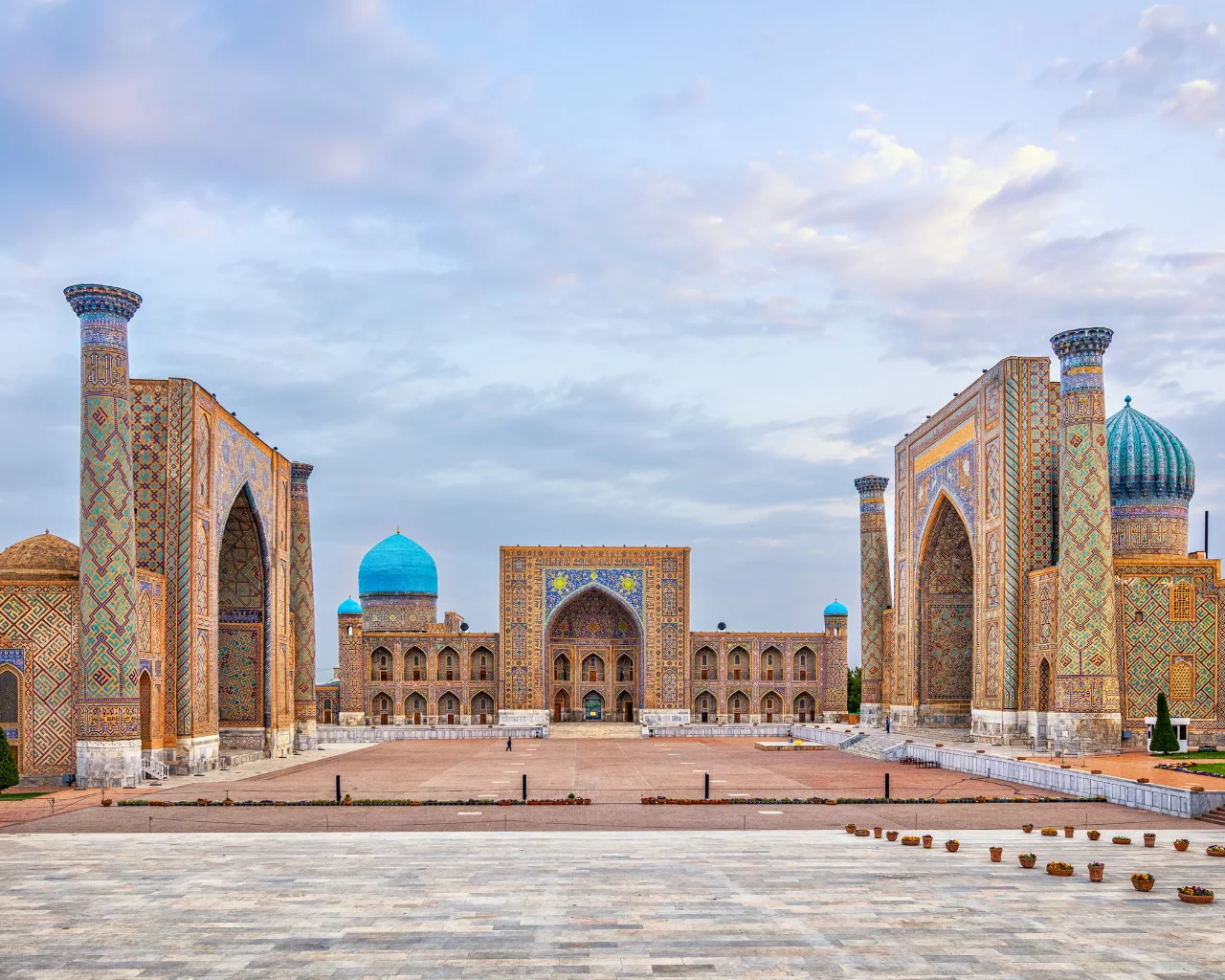
The first thing you notice is the color: turquoise domes catching the sunlight. Deep blue mosaics ripple across the walls like frozen waves. Golden inscriptions circle the arches, shimmering just enough to remind you that this place is not merely a city but a story - one told and retold for nearly three thousand years.
Samarkand is not merely a backdrop you pass through; it is a living presence. It greets you in the echo of footsteps within ancient courtyards, in the aroma of hot bread rising from clay ovens, and in the gentle murmur of voices in the bustling bazaar. Here, the Silk Road has not faded into history; it lingers in the air like dust and light.
Walking Through History’s Oldest Pages
You begin in the heart of the city, where everything converges: Registan. Three madrasas rise around you like colossal open books, their pages inscribed in tile and stone. Standing in the middle of the square, you tilt your head back and let your eyes travel up the facades. Every detail feels deliberate - every star-shaped motif and swirling vine reminds you that beauty here was never accidental.
It’s easy to imagine what this space looked like centuries ago, when caravans arrived from distant lands - traders unloading silk and spices, scholars carrying manuscripts under their arms, and students racing through archways to their lessons. Registan seems to hold the echoes of dozens of worlds simultaneously.
Samarkand itself originated in the mists of antiquity. Known as Marakanda, it was admired by Alexander the Great. Later, it became a vibrant hub on the Silk Road - one of the great meeting points between East and West. Standing in its streets today, you can feel the weight of those passing centuries like warm sunlight on your shoulders.
Timurid Glory: The City of Conquerors and Stargazers
To understand the heart of Samarkand, you must follow the path of Amir Timur, who chose this city as the center of his empire. He summoned artisans, architects, and thinkers from every corner of his realm, shaping Samarkand into a monumental capital designed to rival the greatest cities in the world.
His legacy becomes tangible in the quiet grandeur of Gur-e Amir. From the outside, the blue dome rises like a perfect globe. Step inside, however, and the space glows with gold and shadow - a chamber so intricate and serene that you momentarily forget to breathe. Timur rests here, but the beauty surrounding him feels alive.
Yet, Samarkand is not only a city of conquerors. It is also the city of Ulugh Beg, Timur’s grandson, who loved the stars more than he loved war. In his observatory, scholars charted the heavens with astonishing precision. The remnants of his giant sextant still carve a perfect arc into the earth - a reminder that Samarkand’s greatness was built not only with swords but also with curiosity.
A Living City: Culture, Craft, and the Rhythm of Everyday Life
Beyond the monuments lies a more tranquil Samarkand.
Mornings begin with the aroma of freshly baked bread coming from tandoor ovens, the sound of children calling to each other as they walk to school, and the quiet hum of neighbors greeting one another beneath mulberry trees. Life here moves at a pace that feels both timeless and deeply human.
In narrow streets, you might see a craftsman shaping ceramic bowls just as his grandfather once did, or a woman hanging fresh suzani embroidery in the doorway of her shop. Soft and steady, the music of Shashmaqom floats from open windows. Tea houses fill with lively conversation. Families gather not only to eat but also to share the small moments that hold a day together.
At Siab Bazaar, the city comes vividly alive. Pyramids of dried apricots gleam in the sunlight. Spices release warm, inviting aromas into the air. Vendors effortlessly switch between Uzbek, Tajik, and Russian as they call out prices and invite you to sample their wares. Here, language and culture blend seamlessly, just as they always have - fluidly and naturally.
Samarkand’s culture is not performed for visitors; it thrives because people live it every day.
The Soul of the People
What stays with you long after leaving Samarkand is the kindness deeply embedded in its culture.
You encounter an elderly vendor who insists you try a dried fig. A family invites you in for tea and sweets, dismissing your polite refusals with warm laughter. Children stand shyly at first, then follow you down the street, curious and smiling.
Hospitality here is not merely a custom - it is a natural instinct. To be a guest in Samarkand means to be welcomed wholeheartedly and warmly, regardless of who you are or where you come from.
The blend of Uzbek and Tajik heritage shapes the city’s identity. You hear it in the mingling of languages, see it in the patterns of clothing, and feel it in the rhythms of daily life. Samarkand has always been a crossroads, and its people carry this history with grace.
Samarkand’s Place in the Heart of Uzbekistan
For Uzbekistan, Samarkand is more than just a city. It is a symbol of creativity, endurance, and the brilliance that emerges when cultures converge.
It appears in schoolbooks, is proudly retold in stories, and echoed in songs. The nation cherishes its domes, its scholars, and its legends as integral parts of its identity. To speak of Samarkand is to speak of what makes Uzbekistan culturally vibrant, spiritually rich, and deeply rooted in history.
In Central Asia, where countless cities have risen and fallen, Samarkand stands as a testament to the enduring power of beauty and knowledge amid the passage of empires.
Practical Tips Woven into the Journey
While Samarkand feels like a dreamscape, the details of travel matter - and they seamlessly blend into your experience.
The best seasons to visit are spring and autumn, when the city reveals itself gently, with soft breezes and warm light. Summer blazes with heat, and winter brings a quiet calm, but Samarkand is beautiful in every season.
You primarily travel on foot, allowing the city to guide you from one landmark to the next. When distances become longer, taxis or ride-sharing apps are readily available, and drivers are warm, curious, and eager to chat.
Bottled water becomes second nature; bazaars invite you to explore their treasures; and if a café is full of locals, you know you’ve found the perfect spot for lunch. In mosques and sacred sites, covering your shoulders and knees is sufficient. Carrying a scarf tucked in your bag is always a good idea.
Samarkand does not impose strict rules on you; it simply asks for respect - for its faith, its people, and its stories.
A City That Stays with You
Eventually, your time in Samarkand comes to a peaceful close.
Perhaps you return to Registan after dark, when the domes glow softly beneath golden lights and the square feels expansive and hushed. Or maybe you take a leisurely walk down a street where families gather outside, drinking tea and talking as children ride their bikes in circles.
You stop, breathe, look up at the stars, and feel something shift inside you - a sense that you are standing not in a city, but within a living memory.
Samarkand has that effect on people. It envelops you, drawing you into its story. Long after you leave - whether by train, plane, or road - you carry its colors, scents, voices, and warmth with you. They settle in your mind like glowing shards of tile, becoming part of your own story.
Because Samarkand is not just a place to visit; it is a place to feel, to live, and to cherish.
And in some quiet way, it keeps you, too.

Suggested Adventures
Browse our related tours to find your next unforgettable journey


Related Posts
Lorem ipsum dolor sit amet, consectetur adipiscing elit.
.webp)
What You Need to Know Before Traveling to Uzbekistan

Unveiling the Mystical 5 Stans of Central Asia

Chimgan Mountains: Where Uzbekistan’s Peaks Touch the Sky
.webp)
Khiva: A Journey Into the Heart of the Silk Road
.webp)
Kyzylkum Desert: Where Silence Holds the Stories of a Thousand Suns
.webp)
Bukhara: A City Woven From Sand, Light, and Sacred History