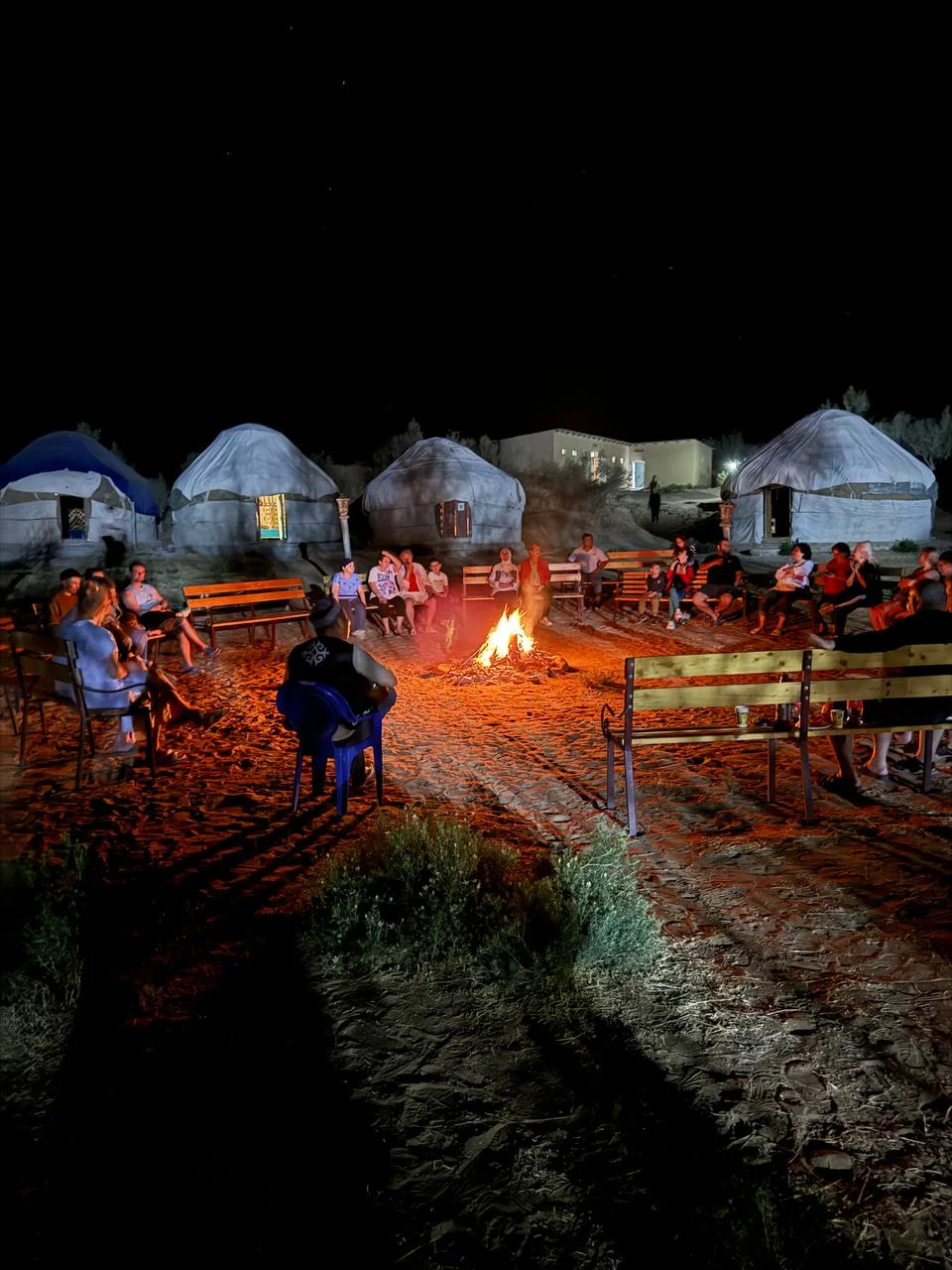
Bukhara: A City Woven From Sand, Light, and Sacred History
.webp)
Bukhara: A City Woven from Sand, Light, and Sacred History
Arriving in Bukhara feels like stepping into a dream sculpted from sun-washed bricks and ancient memories. The city emerges slowly from the desert - not with the dramatic domes of Samarkand, but with something quieter, deeper: an old soul that reveals itself through whispered stories, shadowed alleyways, and the warm glow of clay-colored walls at sunset.
Bukhara doesn’t try to impress you, and it doesn’t need to. Its beauty lies in the way time lingers here - unhurried and unbroken - as if centuries have folded themselves into the narrow streets and blue-tiled cupolas. When the desert breeze drifts through the old town, carrying the scent of spices and warm earth, you feel as though you’ve entered a living museum that has been breathing for over two thousand years.
This is a city that has witnessed empires rise and fall, scholars debating under the cover of night, and caravans slipping through its gates in long, dusty lines. Yet, Bukhara stands unshaken - a sanctuary of history and faith in the heart of Central Asia.
A Tapestry of Empires and Knowledge
Walking through Bukhara is like reading a manuscript crafted from mudbrick and turquoise.
Long before Uzbekistan existed and before the Silk Road wove its golden threads across continents, there was Bukhara. It flourished under Persian empires, grew radiant under Islamic dynasties, and became a center of scholarship during the Samanid period. From the 9th to 10th centuries, its thinkers shaped theology, law, poetry, and philosophy - not only for Central Asia but for the entire Islamic world.
You sense the enormity as you stand before the Ark Fortress, its curved walls rising like a sand-colored mountain. The Ark was not merely a fortress - it was a world unto itself, encompassing mosques, palaces, courts, and homes. It served as the beating heart of Bukhara, the seat of its rulers, and a place where history was shaped, judged, and celebrated.
Nearby stands the Samanid Mausoleum, a perfect cube of baked brick whose delicate geometry interacts with sunlight in a way that feels almost spiritual. It appears simple at first glance, but the closer you look, the more intricate it becomes. Patterns dance across the brickwork, revealing a sophistication that seems centuries ahead of its time.
And then there is the Kalyan Minaret, the towering beacon that once guided caravans across the desert. Genghis Khan himself is said to have spared it out of awe - and when you stand beneath it, feeling impossibly small, you understand why. Its height, texture, and solemn presence - everything about it commands respect.
Bukhara’s history is not a distant echo; it is present, immediate, and woven into every step you take.
A City of Faith and Quiet Reverence
More than any other city in Uzbekistan, Bukhara exudes a profound sense of spirituality.
This spirituality is neither loud nor dogmatic - it is quieter, like a gentle pulse beneath your feet. It dwells in the courtyards of ancient madrasas, where the air remains cool and still even on the hottest days. It lingers beneath the domes of mosques, where light filters down in slender, glowing rays, illuminating carpets and tiled walls with a serene warmth.
At Poi Kalyan, where the grand mosque and minaret stand side by side, you can feel the weight of centuries of prayer. The vast courtyard seems to hold the very breath of history itself. If you stand there alone early in the morning, your footsteps echo across the stone so clearly that it feels as if you have slipped into another time.
Down narrow lanes and past intricately carved wooden doors, you’ll find smaller mosques - some hidden, others standing proudly in open squares. People move in and out quietly. A man washes his hands and face beside a fountain, while a boy carries a bag of bread home to his family. Here, life and faith merge effortlessly, each complementing the other without interruption.
Bukhara’s spiritual heart beats slowly and steadily, guiding everything around it.
Everyday Life Beneath Ancient Domes
While Samarkand dazzles with grandeur, Bukhara enchants with its intimate charm.
The city feels lived-in - warm, human, and familiar. You hear the clatter of cups as tea is poured in chaikhanas shaded by ancient mulberry trees. You see craftsmen bent over carpets, embroidering patterns that trace back generations. You pass women bargaining for figs in the marketplace, their voices rising and falling like a melody.
In the center of the old town, Lyabi-Hauz is where everyone eventually gathers—locals, travelers, elders, and students. The pool reflects the sky in soft blues and golds, while ducks paddle lazily across the water. Old men sit on benches, sipping tea and playing backgammon. The rhythm here is slow; conversations stretch into the afternoon, and no one seems in a hurry to leave.
This is the Bukhara you will remember long after you have gone: the way time stretches, the way the simplest scenes feel rich with meaning, and the way hospitality feels as natural as breathing.
Craft, Color, and the Living Silk Road
Bukhara has always been a city of skilled artisans. You see them in the bazaars, nestled beneath domed trading halls built centuries ago to protect merchants from the desert heat. The Toki-Zargaron, Toki-Sarrafon, and Toki-Tilpak-Furushon stand like great stone shells, their interiors vibrant with color and texture.
Silk scarves flutter like desert butterflies. Handwoven carpets glow with deep reds and indigos. Jewelry is crafted from silver filigree so fine it seems spun from air. Ceramics, embroidered jackets, and carved wooden boxes - each object feels like a story in your hands.
Craftsmanship isn’t a performance for visitors; it’s a heritage jealously guarded and lovingly passed down. When you watch a craftsman at work, you are witnessing not just a skill, but a lineage.
And always, you sense the ghost of the Silk Road - it lingers in the spice stalls, the intricate patterns of textiles, and the conversations that blend Uzbek with Tajik, Russian, and occasionally Persian.
Bukhara has always been a place of convergence - and it remains so today.
The People Who Give the City Its Soul
If architecture gives Bukhara its face, its people give it its heartbeat. You meet a ceramic artist who eagerly shows you how he mixes his glaze. A shopkeeper offers you tea before ever mentioning the price. A child runs up to say hello, shy but curious. An elderly woman nods at you in quiet acknowledgment as she passes by.
In Bukhara, hospitality is not merely a gesture - it is an instinct. You are offered tea so frequently that eventually, you stop refusing. You sit, you drink, and you allow conversations to unfold slowly. You become part of the city’s rhythm.
Languages intertwine in the air. Uzbek, Tajik, and Russian flow effortlessly among the people, a reminder that Bukhara has always embraced diversity rather than resisted it. Here, you never feel like a stranger; instead, you feel like a temporary citizen of this ancient, gentle place.
Bukhara’s Significance in Uzbek Identity
While Samarkand dazzles with imperial grandeur, Bukhara embodies the soul of Uzbekistan.
It is the cradle of Islamic scholarship, the center of Sufi mysticism, and the guardian of some of the most sacred sites in Central Asia. For centuries, to speak of Bukhara was to evoke learning, devotion, and refined culture. Its scholars shaped the religious and philosophical life of the region, while its poets and thinkers produced writings that are still studied today.
Even today, Bukhara retains profound cultural significance. It is a city of balance - between faith and daily life, between beauty and restraint, and between the weight of history and the ease of the present.
Uzbekistan’s heart beats in many places, but Bukhara is where its spiritual pulse is the strongest.
Practical Wisdom for Exploring the Old City
Traveling in Bukhara doesn’t feel like managing logistics; it feels like stepping into a slower, more tranquil world.
Walk as much as possible. The old city is compact and inviting, with streets that wind gently between monuments, teahouses, and tranquil squares.
Spring and autumn envelop Bukhara in warm light and mild temperatures. Summer blazes intensely, while winter is crisp yet tranquil. Each season imparts a distinct character to the city—vibrant, languid, contemplative, or serene.
Carrying some cash is useful in bazaars and small shops, while cards are accepted in more modern establishments. Women should bring a scarf, and everyone should wear respectful clothing and comfortable shoes.
No one rushes here. You might find yourself spending half a day in a café by Lyabi-Hauz without even realizing it. Let it happen. Bukhara rewards travelers who allow the city to set the pace.
A Farewell Engraved in Warm Stone
On your final evening in Bukhara, the city feels softer, as if it is deliberately slipping into a quieter version of itself. The air cools, the sun sinks behind the low rooftops, and the old city begins to glow with a muted amber light. You may find yourself drifting toward Lyabi-Hauz, drawn not by intention but by instinct, to sit beneath the ancient mulberry trees as their leaves rustle gently overhead.
People gather here in ways that feel almost ceremonial, yet never formal. A group of friends leans in close over shared plates; an elderly man reads his newspaper with slow, deliberate gestures; children chase each other around the water’s edge. Nothing extraordinary happens, yet everything feels meaningful. You realize that Bukhara’s magic has never been about grand gestures - it lives in these small, effortless moments.
As night falls, lanterns flicker to life in the courtyards and alleyways. You wander aimlessly, guided only by the sound of distant laughter or the warm glow spilling from a teahouse doorway. There is a gentle softness to the city at this hour, as if it is tucking itself in, folding the day carefully like a cherished piece of cloth.
You pause before a carved wooden doorway, tracing its intricate patterns with your eyes, wondering how many hands have shaped this wood and how many stories it has guarded. A breeze sweeps through the street, carrying the scent of freshly baked dough and spices. You breathe in slowly, wanting to anchor this moment deep within your memory.
When you eventually leave Bukhara, it doesn’t feel like moving away from a place - it feels like leaving behind a mood, a state of mind. The city doesn’t chase after you or demand to be remembered. Instead, it leaves a gentle imprint: the hush of shaded courtyards, the rhythm of desert evenings, and the kindness of strangers whose names you never learned.

Suggested Adventures
Browse our related tours to find your next unforgettable journey


Related Posts
Lorem ipsum dolor sit amet, consectetur adipiscing elit.

Unveiling the Mystical 5 Stans of Central Asia
.webp)
What You Need to Know Before Traveling to Uzbekistan

Chimgan Mountains: Where Uzbekistan’s Peaks Touch the Sky
.webp)
Samarkand: Where Time Wears a Turquoise Crown
.webp)
Khiva: A Journey Into the Heart of the Silk Road
.webp)
Kyzylkum Desert: Where Silence Holds the Stories of a Thousand Suns